
Reading time:
8 min
Inflation in Switzerland
If you are wondering how best to protect your savings from inflation, you are not alone. Your feeling that the prices of everyday goods are rising in many places is not deceiving you. The phenomenon of inflation is also a reality in Switzerland. As a result, the purchasing power of your funds is constantly decreasing. We will show you how you can counteract this.
THE MOST IMPORTANT POINTS AT A GLANCE:
Inflation works unnoticed. Do not underestimate it. It is a creeping process that shrinks your savings piece by piece in the long term.
Over the last 50 years, 100 Swiss Francs have lost 36 % of their purchasing power.
The best remedy against inflation is a broadly diversified investment solution with a focus on tangible assets.
Index
What is inflation?
According to the Federal Statistical Office, inflation in 2025, as measured by the national consumer price index, increased by 0.2% compared to the previous year.
All prices fluctuate, some daily, others at irregular intervals. This can vary greatly depending on the product or service. When prices rise generally, we speak of inflation. If you are particularly attentive, you will notice this in your everyday life, whether at "Zmorge at the bakery", chatting over a "Kafi", or having an "after-work beer" in your local pub.
A look back at the last 50 years, however, shows the price development impressively:
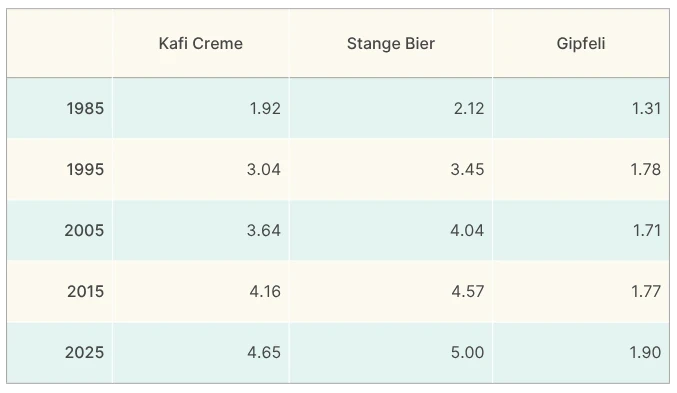
While the croissant became "only" around 45% more expensive, the prices of "Kafi Creme" and a "draft beer" (3dl) in restaurants multiplied over the last decades. While 50 years ago a five-franc coin could buy you 2.6 cups of coffee on average in Switzerland, today it is barely enough for one, and in some urban spots you even have to pay significantly more.
The consequences of inflation probably don't catch your attention in daily life. It is a slow-acting poison that negatively impacts your savings over the long term.
But even just 20 years ago, you got significantly "more for your money".
Inflation in Switzerland
If you are interested in the price increase of all your consumer spending, the Federal Statistical Office can help. The federal authority measures inflation in Switzerland using the National Consumer Price Index (CPI). Its statisticians establish a basket of goods each year that represents the consumer behavior of the average Swiss household as closely as possible. It includes goods and services on which Swiss residents spend their money. Over time, they measure the general rise in prices for this basket of goods.
Of course, this is a strong generalization and your own consumer behavior may differ significantly. If you want to calculate your "own" inflation for recent years, you can do so using the Individual Inflation Calculator.
In 2025, an average inflation rate of 0.2% was measured. So if you spent 100 francs on an average purchase in 2024, it was 100.20 francs in the following year. Or put another way: your purchasing power was reduced by 0.2%.
It is highly likely that banks will continue to pay little to no interest on savings accounts in the future. Therefore, you should act now to combat inflation on your savings.
The following graphic shows you the loss of purchasing power in Switzerland since 1985:
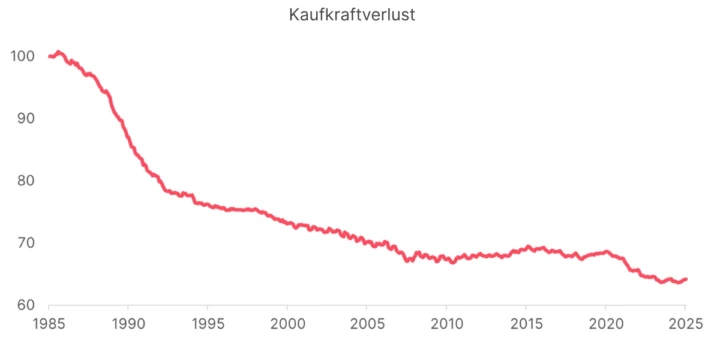
Your money lost nearly 36% of its value over the last 50 years. This results in an annual inflation rate of around 0.9%. Swiss residents had to accept a loss of purchasing power almost every year, although it varied. While annual inflation of over 2% was not uncommon in the 1980s, prices remained almost stable between 2006 and 2020. Only the consequences of the Covid-19 pandemic brought inflation back into the headlines and thus also "into your wallet".
The historical evidence of an average of around 1% inflation per year is no coincidence. The Swiss National Bank (SNB) has the mandate to ensure price stability in Switzerland. It considers price stability to be achieved when the annual rise in the CPI is between 0 and 2%. To achieve this, the SNB manages its monetary policy using various instruments. For example, it determines its policy rate quarterly or influences the exchange rate of the Swiss franc against global key currencies such as the US dollar or the euro through targeted interventions.
Switzerland is therefore among the countries with the most stable prices. This contributes to the long-term positive development of the national economy.
How inflation arises
There are several causes for rising prices, which usually interact. Countless books have been written about this, and millions of economists, politicians, and investors ponder it daily. Simplified, literature sees two main paths for how inflation arises:
Demand exceeds supply: If we all want to buy "more" at the same time, demand increases. If suppliers cannot keep up with their production or if their supply stays the same, they raise their prices. This happened exemplary after the outbreak of the Covid-19 pandemic: many people spent state support on online purchases while production stalled due to lockdowns.
Supply falls below demand: If the supply of raw materials or labor decreases while demand stays the same, prices rise. Currently, this can be observed as a result of conflicts in the Middle East, which make energy prices more expensive. These higher input prices increase the manufacturing and transport costs of many goods.
These two causes are the most common in Switzerland. In addition, there are other paths, such as an irresponsibly loose monetary policy by the central bank, a sharp decline in currency value, or sharply rising price expectations, which, however, usually play a minor role for us.
What helps against inflation
Inflation is a fact, also in Switzerland. It affects your savings. Whether you store your money under your pillow or parked in a savings account at the bank makes no difference. Your savings are continuously losing value. What can you do?
Invest your savings. Focus on tangible assets. Compared to monetary assets, tangible assets can compensate for inflation over time.
Monetary assets are a "promise on paper". You lend your money to debtors like banks, the government, or companies, and receive debt securities in return. In the best case, you receive regular and fixed interest payments as well as repayment at the "end of the contract". This includes your savings account or bonds.
Tangible assets, on the other hand, you can see and touch. They exist physically and have material value. These include precious metals, real estate, and equities. The latter are shares in companies and allow you to own parts or entire companies.
Tangible assets protect you better against inflation over time than monetary assets. Why?
Real estate: A real estate portfolio does not lose its value, even if money devalues. The land it stands on is limited. Since construction materials and wages rise due to inflation, building becomes more expensive as well. This automatically pushes up prices for existing real estate.
Equities: Companies can raise their prices when everything becomes more expensive. This allows them to secure their profits and maintain their earning power. This enables them to pay out higher dividends, which supports the value of the company and thus the stock price in the long term.
Precious metals: The global gold stock cannot be arbitrarily increased. Because it remains scarce, it retains its purchasing power over decades. It is seen by many as a rock in the surf when trust in paper money wanes.
If, on the other hand, you have invested your money in fixed-interest bonds, no adjustment for inflation takes place. Such an adjustment hardly happens either when you park your savings in a savings account. Banks usually react with delay and restraint regarding interest rate hikes. If they pay you any interest at all, it is usually significantly lower than inflation. In short, your money is constantly losing value.
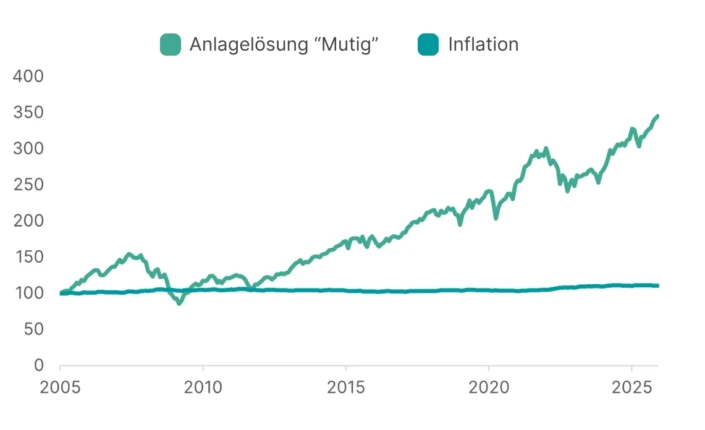
The best remedy against inflation is a broadly diversified investment solution with a focus on tangible assets.
The following graphic demonstrates this impressively. Our "Brave" investment solution invests 80% in equities, 10% in Swiss real estate funds, and 10% in bonds and liquidity in Swiss francs.
What you can do now – Your checklist
Understand what inflation is and what it means for you (our article helps you with this).
Get an overview of your finances and create a budget.
Determine your emergency cushion that you keep liquid on a bank account at all times (3 to 6 months of living expenses are recommended depending on your life situation).
Set your investment amount (the rest of your savings) and invest it in a diversified way with a focus on tangible assets.
Choose a provider that fits you and offers a simple and transparent investment solution at low fees.
Stick to your financial plan and investment strategy with discipline and a long-term mindset, as long as your living situation does not fundamentally change.