Reading time:
15 min
Broker or Asset Manager
You’ve taken the first step, congratulations. You’ve decided to make more out of your savings. Instead of letting your savings account balance languish with little or no interest, your money should start working for you. When it comes to investing, the same principle applies as in many other areas of life: You can either do it yourself or delegate. These two options place different demands on investors in terms of knowledge and time. But what exactly is a broker or a trading platform? What are the responsibilities of a wealth manager? We’ll answer these questions in this article and provide you with decision-making guidance. To keep things clear, we have directly compared all relevant criteria for both options – on the left, «do-it-yourself» and on the right, delegation to an asset manager.
THE MOST IMPORTANT POINTS AT A GLANCE:
A Broker is the right choice for you if:
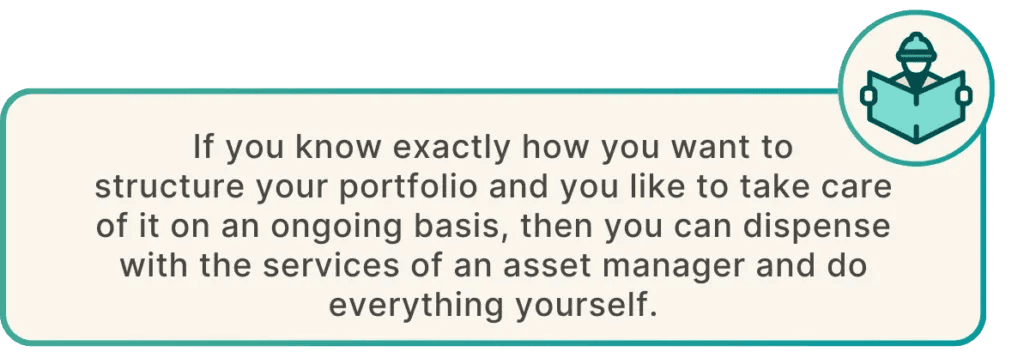
if you have comprehensive investment knowledge that allows you to make good investment decisions yourself.
if you enjoy selecting, buying and selling investment instruments yourself and want a wide range of products and full flexibility.
if you don’t mind if your tax return takes longer because you have to enter your investments and income manually or are prepared to pay for the e-tax statement.
if you invest independently in a disciplined manner and don’t fall for the lure of brokers offering expensive financial products.
An asset manager is the right choice for you if:
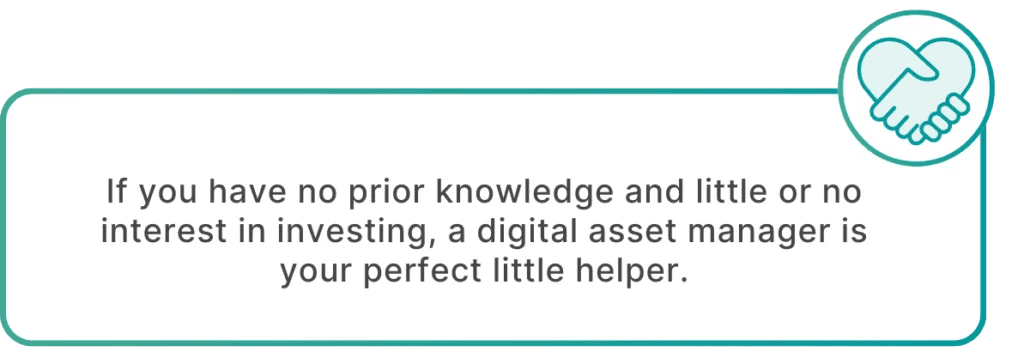
if you have little or no investment knowledge and don’t feel like reading up on the subject.
if you are looking for a convenient solution for investment decisions and ETF selection.
if you want to invest in a relaxed manner without having to follow the daily events on the financial markets.
if you value professional guidance and relevant information.
if you are looking for a partner who will support you in building up your wealth and will also help you through turbulent times on the financial markets.
Conclusion:
The additional costs of a smart digital wealth management service are so low that you really don’t have to do it yourself if you don’t want to. If you choose to delegate, your digital wealth manager will do all the work, and you’ll have more free time to use however you like.
Index
Security
In principle, there are more or less reputable providers in both cases. As a general rule, it is worth checking whether the provider is actually authorised by the financial market supervisory authority (FINMA in Switzerland). Of course, there are also serious foreign providers. But they often do not offer a Swiss electronic tax statement and, in the event of a major problem, Swiss law does not apply either.
Business models
To make an informed decision, it is also worth taking a brief look at the companies behind the ETF savings plans (brokers) and ETF investment solutions (asset managers). The business models differ significantly.
Broker
The main business of brokers is to enable their customers to trade in securities. The (main) fees are transaction-based. This means that the broker earns from the customer’s trading. It is more important for the broker’s profit that customers trade a lot than that they actually build up assets.
As a rule, not only ETFs or shares can be traded via the broker, but also financial instruments such as CFDs (contract for difference), cryptocurrencies, structured products or other derivatives. Brokers generate a large proportion of their turnover from these. One of the largest online brokers in the USA, Robinhood, for example, only earns around 10% of its turnover from shares and ETFs. This turnover usually comes at the expense of investors, most of whom lose money with these complicated financial products.
Free ETF savings plans or free share trading are often used as a decoy product to attract new customers. Once the customer is on board, attempts are made to persuade them to buy the more expensive products via webinars, stock market tips, etc. As mentioned, the broker earns significantly more with the complicated financial products.
Asset manager
The main business of (digital) asset managers is to invest the client’s money and select the investments. The asset management fee depends on the customer’s investment amount. There is often a discount for large investment sums. This means that the asset manager has an interest in ensuring that the investments increase in value over time and that wealth is built up. This means that a good asset manager will also support you in times of crisis and help you to keep a cool head and hold on to your investments.
Digital asset managers generally only use ETFs from the leading providers on the market for their clients. They do not accept any payments from ETF providers and select ETFs exclusively in the interests of their clients.
Prior Knowledge and Time Commitment
Do it yourself
If you decide to invest in individual stocks, in-depth knowledge is required. Even if you believe you know a company and its products well (e.g., Apple, Volkswagen, Nintendo), this does not indicate the future stock price development. A single company can either skyrocket (Apple, Novo Nordisk) or go bankrupt (Swissair, Credit Suisse). An individual stock therefore carries a significantly higher risk (of total loss) compared to a well-diversified portfolio or an ETF.
Since financial markets are constantly changing, it is crucial that you stay up to date, read industry articles, and continue learning. The time commitment can become quite significant depending on your investment strategy, and you should definitely have prior knowledge as well as enjoy studying the financial markets.
Summary
Extensive prior knowledge required -
High time expenditure for the initial setup -
Average time required for ongoing management -
Continuous training necessary -
Can be pursued as a hobby +
Digital Asset Manager
With an all-in-one worry-free app like findependent, you need no prior knowledge of investing. You go through a short questionnaire, and we recommend one of our five ready-made investment solutions. You also don’t need to regularly manage your investments yourself.
Findependent takes care of the monitoring and management for you.
If you are still interested in learning more, you can access as much information as you like. Through our app or website, in one of our webinars, in a personal online consultation, or by meeting us at one of our regular events.
Summary
No prior knowledge required +
Maximum 15 minutes for initial set-up +
No time required for ongoing management +
No ongoing training necessary +
Free time can be used for other hobbies +
Asset Allocation, Asset Classes, and Investment Strategy
Do it yourself
To determine the right allocation between different asset classes, such as stocks and bonds, you should ask yourself questions about expected returns, investment duration, risk tolerance, behavior during market downturns, etc.
As a result, you should establish a broad, strategic wealth distribution, for example, 50% stocks, 30% bonds, 20% real estate.
Additionally, you should decide on the proportion of foreign currencies and how much of your wealth should be invested in Swiss francs.
Summary
High flexibility in choosing asset classes, countries, and sectors +
A mix of ETFs, direct investments, and crypto is possible +
Investments on foreign stock exchanges are also possible +
Huge universe of available investment instruments +
Full responsibility for the chosen asset allocation +
Digital Asset Manager
You are guided through a structured questionnaire and will find out within minutes which wealth distribution suits you best. You can accept the suggested investment solution or choose a different investment strategy.
The longer your chosen investment horizon and the higher your risk appetite, the greater the weighting of stocks in your portfolio. The asset classes used by findependent include stocks, bonds, real estate, and precious metals.
Your savings are invested in a global portfolio with a strong focus on Switzerland. This ensures that you always have a Swiss franc allocation of 40-80%, depending on the chosen investment solution (the more defensive, the higher the CHF share).
Your chosen wealth distribution remains consistent even after significant market fluctuations and is automatically rebalanced by us, so you don’t have to do anything.
Summary
Ready-made investment solutions invest in equities, bonds, real estate and precious metals +
ETFs pre-selected and defined +
No individualization of the ready-to-use investment solution -
Own investment solution from 5’000 francs !
Renowned investment committee determines asset allocation +
Investment Instruments
Do it yourself
To implement your chosen investment strategy, you first need to search for the right instruments. In addition to individual stocks, you can also choose collective investment instruments, such as bond funds or equity ETFs. You can also select from a seemingly endless number of structured products and warrants.
If you decide to invest in individual stocks, in-depth knowledge is required. Even if you believe you know a company and its products well (e.g., Apple, Volkswagen, Nintendo), this does not indicate the future price movement of the stock. A single company can either “skyrocket” (Apple, Novo Nordisk) or go bankrupt (Swissair, Credit Suisse). Therefore, an individual stock carries a significantly higher risk (of total loss) than a broadly diversified portfolio or ETF.
If you invest in structured products, ETCs, or ETNs (Exchange Traded Commodities and Notes) and similar securities, you should definitely keep an eye on the counterparty risk. The counterparty is the issuer of the security, not the underlying company. Unlike ETFs, such securities are not protected as segregated assets in the event of the counterparty’s bankruptcy. Instead, they fall into the bankrupt
Summary
Instruments can be selected that are outside the regulatory scope and/or offer excessive opportunities & risks !
Search for individual titles very time-consuming -
Individual securities (shares, bonds, etc.) do not cost a management fee +
From lucky punch (Nvidia, +2,700% in 5 years) to total loss (Swissair, Enron, Credit Suisse), anything is possible !
Digital Asset Manager
Instead of directly investing in stocks, bonds, real estate, and precious metals, findependent exclusively uses ETFs (exchange-traded funds). From a jungle of over 1’500 ETFs traded on the Swiss stock exchange, our investment committee has selected the appropriate ETFs and created five ready-made investment solutions.
Regardless of the investment solution, these are always the same ETFs, but with different weightings. Additionally, not all of the selected 11 ETFs are included in every investment solution. For example, a pure equity strategy doesn’t require bond and real estate ETFs.
The selected ETFs by findependent have very low total expense ratios (Total Expense Ratio TER), and each of these ETFs covers an entire bond, stock, or real estate market.
Only established ETFs from leading providers are used, all with high trading volumes and can be bought and sold at any time. There are no opaque financial constructs hidden behind the ETFs, and the investments are held directly.
Summary
Exclusively ETFs, pre-selected by findependent !
Additional security as special assets +
ETFs are very cheap, but not entirely free (TER approx. 0.15% p.a.) -
Invested in more than 3’000 individual stocks +
Currency Risks
Do it yourself
The instruments you choose may not only invest in Swiss Francs. A US equity fund, for example, is usually denominated in US Dollars, thus carrying a currency risk. The past decades have been characterized by a very strong Swiss Franc. The US Dollar and even the Euro have lost about 40% of their value against the Swiss Franc in the last 20 years. How different currencies will develop against the Swiss Franc in the future no one can predict with certainty.
Generally speaking, it can be assumed that a global (equity) portfolio will yield a slightly higher return in local currency than a portfolio with a higher proportion of Swiss Francs. In order for the excess return to persist, the local currency (e.g., USD or EUR) must either remain stable or appreciate against the Swiss Franc.
Equity funds are very rarely hedged against the Swiss Franc. Even if the fund is priced in francs, it still includes currency fluctuations. The development in francs is simply the development in local currency, adjusted for the exchange rate changes (both up and down).
Summary
Individual weighting of foreign currencies is possible +
Pure portfolio in USD or increased risk profile possible +
More foreign currency = higher risk !
Investment in currency-hedged instruments feasible +
Digital Asset Manager
All investment solutions from findependent invest globally, with a heavy focus on Switzerland.
The higher the chosen equity allocation, the higher the proportion of foreign currencies in findependent investment solutions.
Careful (20% equities): 86% Swiss Franc
Cautious (40% equities): 72% Swiss Franc
Balanced (60% equities): 59% Swiss Franc
Brave (80% equities): 47% Swiss Franc
Risky = 100% equities: 39% Swiss Franc
Without this «home bias», the Swiss Franc proportion would be around 3-4% of the total investment amount.
Why does findependent invest so much in Swiss Francs?
Investments in Switzerland or in Swiss Francs do not experience currency fluctuations. An overweighting of Swiss Francs thus provides additional stability to the investment solution. If foreign currencies lose value against the Swiss Franc, the findependent investment solution is much less affected compared to a purely global portfolio.
Summary
Global investment solutions with francs weighting = lower fluctuations in value -
No individual adjustment of the currency possible -
ETFs are not currency-hedged -
Yields slightly lower compared to foreign currency portfolios -
Transaction Costs
Do it yourself
When trading through a trading platform, there are generally fees for each transaction. The amount of the transaction fee, also known as commission, depends on the provider and the type of securities being traded. The range is very large, it can be 0.1% or even 1.0% or more. However, trading platforms typically offer low transaction costs and make their money from the volume of transactions. With regular deposits, however, seemingly low transaction fees can add up over time. It is also important to note that the commission is usually calculated as a percentage of the transaction amount, and there is often a minimum commission, e.g. 20 francs.
Transaction fee in percentage
An example calculation for 12 deposits of 300 francs each. The commission is 0.2% of the transaction amount, i.e., 60 cents each. The 12 deposits thus cost a total of 7.20 francs. At the end of the year, you will have invested 3’600 francs and paid 7.20 francs in transaction fees, which is 0.2% of your investment amount.
Transaction fee in francs
An example calculation for 12 deposits of 300 francs each. The commission is 0.2% but at least 3 francs each. The 12 deposits thus cost a total of 36 francs. At the end of the year, you will have invested 3’600 francs and paid 36 francs in transaction fees, which is 1% of your investment amount.
Each securities transaction on the Swiss stock exchange incurs a stamp duty and a stock exchange fee. Together, this amounts to approximately 0.1% of the transaction amount (for both the purchase and the sale).
Summary
Each transaction costs brokerage & stamp/stock exchange duty -
Some securities tradable without brokerage +
Conditionally suitable for step-by-step assembly -
Digital Asset Manager
The findependent investment solutions incur no transaction costs or commissions. Additional deposits are also free of charge.
For each securities transaction on the Swiss stock exchange, a stamp duty is charged, as well as a stock exchange fee. Together, this roughly amounts to 0.1% of the transaction amount (for both the purchase and the sale).
findependent is well-suited for gradual wealth building. It doesn’t matter if you invest once a month via standing order right after receiving your salary, or if you invest your existing savings from the savings account in multiple steps to generate profits.
Summary
No transaction costs (brokerage fee) +
Stamp/exchange duty also applies here -
Ideally suited for step-by-step investing +
Custody Fees
Do it yourself
You pay a custody fee for the safekeeping of your securities. It is usually calculated as a percentage of the invested amount, typically ranging from 0.1% to 0.5%. Online brokers sometimes cap the fee, e.g., a maximum of 10 CHF per month.
Through Securities Lending, some providers offer free custody. However, you must pay close attention to the security of this arrangement. If you lend your portfolio for securities lending, the securities are no longer treated as segregated assets in case of the bank’s insolvency and instead become part of the bankruptcy estate. To save on the custody fee, it’s not worth taking this risk.
Summary
Custody fee 0.1-0.5% p.a. +
May be capped -
Securities lending with additional risks -
Digital Asset Manager
For the custody of your ETFs, you have a securities account in your name at our partner bank. The custody fee is 0.2% p.a. and is charged quarterly.
This ensures that your assets are safely held in your personal account/depot and are always available to you.
Each customer invests the first 2’000 francs entirely without custody fees. Therefore, we refund a few francs to you every quarter.
Summary
Custody fee 0.2% p.a. +
No capping +
Reimbursement for the first 2’000 francs +
Ongoing Monitoring and Asset Management Fee
Do it yourself
You monitor the securities you’ve purchased and the development of your portfolio regularly after making your transactions.
With individual stocks, the effort is significantly higher, and a daily check is recommended. For broadly diversified ETFs, the effort is somewhat lower, but you should still keep an eye on the weighting of the individual ETFs in your portfolio and adjust them when necessary (which may, in turn, incur transaction costs).
Ongoing monitoring is not only important to ensure you’re holding the right assets but also to ensure that your portfolio is always aligned with your initially defined strategy. For example, if you initially set a goal of 60% stocks and 40% bonds, and the stock market performs very well, it may happen that the allocation shifts to 70/30 over time. You should adjust this if necessary to avoid being invested with more risk than you intended.
Of course, it’s entirely up to you how much monitoring you do, as you’re only accountable to yourself.
The benefit of the Do-it-yourself approach: You’re essentially your own asset manager and don’t have to pay any additional costs, except for your time. But maybe you’ve even made investing your hobby.
Summary
Very time-consuming monitoring -
Adjustments lead to transaction costs -
No asset management fee +
Digital Asset Manager
findependent is your asset manager. For the initial setup, ongoing monitoring, and any necessary adjustments, an asset management fee of 0.09% to 0.2% per year applies. We have a range because as your investment grows (from 50’000 francs), the fees decrease.
With 30’000 francs, you pay 0.2%, and at 150’000 francs, it drops to 0.15%, decreasing to 0.09%.
Of course, the fee waiver applies for your first 2’000 francs or more. So, if you have an investment of 50’000 francs, you will actually pay 0.17%.
Summary
You save time, findependent takes care of all the work +
No transaction costs +
Management fee 0.09% - 0.2% -
Tax Statement
Do it yourself
If you make many transactions throughout the year, there is really no way around a tax statement. Unless you want to manually transfer all purchase and sale dates as well as dividends and interest payments into your tax software. Depending on the trading platform, the electronic tax statement costs an additional 100 francs or more.
Summary
Costs 100 francs and more - per year -
Manual recording very time-consuming -
Digital Asset Manager
To keep it simple here as well, we provide you with an electronic tax statement. You can easily «drag-and-drop» it into your online tax declaration, and within seconds, all fields will be populated with the necessary data.
The tax statement is free at findependent and will be available to you directly in the app around February.
Summary
Free +
Saves a lot of time +
Return Calculation
Do it yourself
You are responsible for calculating the total return of your portfolio. However, many brokers offer pre-calculated return reports. Whether the return is displayed in Swiss francs and before or after the deduction of costs depends on the broker.
The performance of your investments depends not only on the actual price movement but also on the costs and currency fluctuations. For example, if you have an investment in European stocks with a return of 9% and during the same period the Euro has depreciated by 5% against the Swiss franc, your effective return is 4%.
You must also subtract the costs for buying and selling (brokerage) and the custody fee from the performance of your investments to see the actual profit in francs. Or, as Martin Spieler from the Tagesanzeiger (paraphrasing) put it: What matters is only the net return.
If you have total costs of 0.4% per year, you should subtract that from your gross return to get your net return.
Usually, only the time-weighted return is displayed by default. With time-weighted return (TWR), inflows and outflows are ignored. This allows for a comparison of different investment solutions.
Summary
Is your own responsibility !
Many brokers provide ready-made calculations -
Pay attention to net and gross returns !
Mostly only TWR available -
Digital Asset Manager
As your digital asset manager, findependent delivers your net return directly in the app. There, you also have an overview of the overall development of your investments. We display how much you have contributed in total, the total returns you have received, the capital gain or loss, and how much you have paid in fees.
findependent calculates the return in the app as both time-weighted return (TWR, time-weighted return) and money-weighted return (MWR, money-weighted return).
The advantage of the money-weighted return (MWR) is that it takes into account the personal deposit timing. This way, the return displayed in percentage often aligns well with the actual profit or loss in Swiss francs, making it easier to understand.
Summary
Automatic daily calculation +
Transparent overview +
Net return +
TWR and MWR reported +
Total Costs
We have already discussed the costs in various sections. In summary, it looks like this:
Do it yourself via Broker or Bank | Asset management with findependent | |
|---|---|---|
Custody fee | up to 0.5% | 0.2% |
Asset management fee | none | 0.09 – 0.2% |
Product costs | none | 0.15% for ETFs (TER) |
Transaction costs | up to 1.5% per transaction | none |
Conclusion
The same principle applies here as in many other areas of life. Whether it’s the service on your bike, the delivery of your groceries, or the tire change on your car: You can either do it yourself or delegate the task. If you do it yourself, you save some money but pay for it with your free time. If you choose to delegate, your digital wealth manager does all the work, and you have more time for the truly wonderful things in life.